
Efficiency and accuracy in the construction and civil engineering industry are no longer optional; they are a necessity given the fast-shifting nature of the industry. Current projects are larger, more complex, and demand smooth cooperation among multiple stakeholders. This is where Building Consulting Modeling comes in a digital revolution that is transforming how engineers, architects, and contractors plan, design, and execute projects. BIM enhances coordination, minimizes errors, and improves overall project outcomes by streamlining all elements into a shared digital environment supported by advanced BIM Modeling Services.
This blog discusses the efficiency and accuracy of BIM in construction and civil engineering, the main advantages that it can provide, and how it can be used practically by professionals in order to achieve high-quality outcomes.
What is BIM? A Quick Overview
Building information modeling (BIM) is an electronic process that entails the development and management of elaborate 3-dimensional models of the physical and functional attributes of any project. In contrast to conventional 2D drawings, BIM enables all stakeholders to collaborate in a common platform containing real-time information, which is accurate on all aspects of the structure, to architects, engineers, contractors, and the owners.
BIM is not only 3D models; it also involves the representation of data concerning materials, quantities, cost, schedules, and performance. This has rendered it a complete solution to construction and civil engineering projects, enabling teams to make informed choices at any stage of the project lifecycle.
How BIM Enhances Efficiency in Construction Projects
Construction efficiency is not about speed only; rather, it is about how to do away with needless rework, how to prevent time wastage, and how to utilize resources in the best possible way. BIM can help to achieve efficiency in the following aspects:
1. Improved Collaboration Between Stakeholders
Conventionally, construction projects have various teams operating on different plans, which often leads to miscommunication and delays. BIM gathers all project data into a common digital design, allowing contractors, engineers, and architects to work in real time and ensure everyone is operating from the same information. This collaborative approach is especially effective when supported by integrated architectural BIM services that align design intent across disciplines.
For example, during construction, a civil engineering team may spot a structural clash between an HVAC system and a building element early in the process. This level of coordination, combined with expert structural engineering services, helps avoid costly on-site changes and keeps the project running on schedule.
2. Accurate Cost Estimation and Resource Planning
Cost estimation is one of the greatest sources of inefficiency in construction. BIM is a model that incorporates quantity take-offs, material requirements, and labor requirements, and, thus, project managers are able to use it to create accurate cost estimates.
This evidence-based process will make resources efficient to avoid unnecessary wastage and unforeseen costs. The project managers can also model various scenarios in order to optimize the scheduling and resources to use with BIM.
3. Streamlined Construction Scheduling
The 4D modeling can be used in BIM to connect the 3D model with the project schedule. This helps teams to see the construction order and arrange every stage properly.
Through the creation of an artificial timeline of construction, teams can detect potential delays, clashes, or bottlenecks before they occur on site. The result is a construction process that is more efficient, faster, and less prone to interruptions. This level of accuracy is further supported by well-structured Revit family creation services, which ensure model elements behave correctly throughout the project lifecycle.
How BIM Improves Accuracy in Civil Engineering Projects
Civil engineering involves accuracy, which, when wrong, can have a tremendous impact. BIM enhances accuracy in the following ways:
1. Clash Detection and Conflict Resolution
One of the strongest tools in BIM is called clash detection. It helps to determine the conflicts between various systems, such as plumbing, electrical, and structural systems, prior to construction.
As an example, a mechanical and electrical construction engineer can utilize BIM in identifying whether ductwork is located on a structural beam overlap. Through the digital model resolving such conflicts, the team saves the expense of on-site changes, reduces the number of mistakes, and the final build should be exactly as the design meant.
2. Accurate Structural Analysis
Civil works are projects that are based on accurate calculations to ensure stability and safety. BIM also includes structural analysis tools that enable the engineers to test the loads, stresses, and materials virtually.
This implies that the choice of beams, columns, or foundations uses real-time data, which is accurate, hence minimizing the chances of structural failures. High compliance with building codes and the overall quality of the project are also enhanced by the right modeling.
3. Precise Material Specifications and Procurement
BIM models have all the information about the materials to be used in a project. This enables MEP consultants and construction teams to get what is required in the exact amount and reduce mistakes and wastage. Proper material planning is also helpful in eliminating delays that may be caused by a shortage or overriding.
In the design of plumbing systems, electrical, or HVAC systems, the BIM ensures that all the components fit the structure without any errors or damage to the integrity of the project.
Key Benefits of BIM in Construction and Civil Engineering
In addition to efficiency and accuracy, the BIM technology has various advantages that change the project delivery approach:
1. Enhanced Visualization
The 3D models in BIM give a vivid picture of the project, and the stakeholders can view the result before the start of the construction process. This is useful in approvals of designs, the presentation to the clients, and problem identification at an early stage.
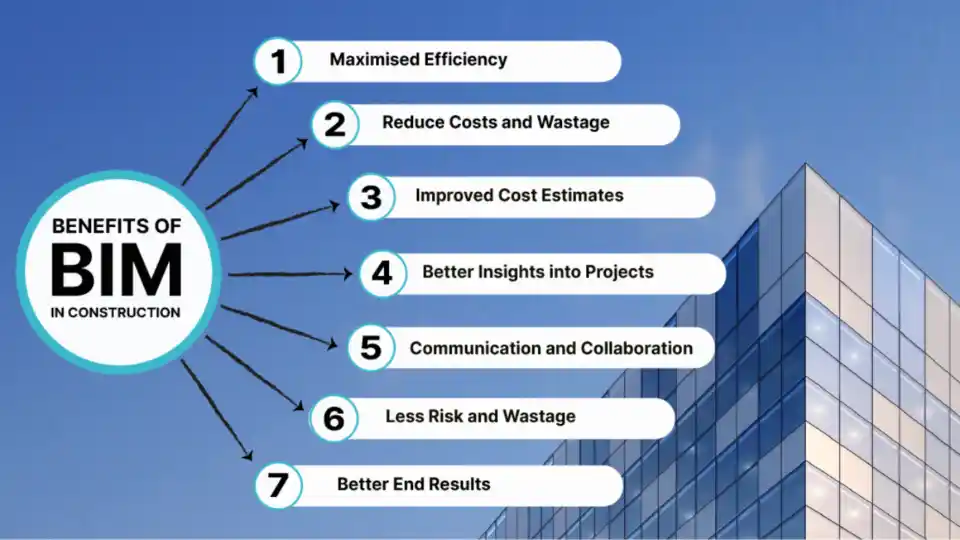
2. Reduced Costs and Waste
BIM saves time and money because it minimizes rework, time delay, and material waste by clash identification, scheduling optimization, and material planning.
3. Improved Risk Management
BIM is not only handy in building construction but also throughout the lifecycle of a structure. The model is a long-term asset since it can be used by the facility managers in maintenance, renovations, and energy management.
4. Better Lifecycle Management
BIM design assists in designing building systems that are sustainable through analysis of energy consumption, lighting, HVAC efficiency, and water systems. HVAC engineering teams and civil engineers can prepare designs to satisfy the green building requirements and minimize the environmental footprint.
5. Sustainability and Energy Efficiency
BIM helps design sustainable building systems by analyzing energy use, lighting, HVAC efficiency, and water systems. Civil engineers and HVAC engineering teams can optimize designs to meet green building standards and reduce the environmental footprint.
How BIM Supports MEP Engineering Services
MEP systems (mechanical, electrical, and plumbing) are critical in any building. BIM enhances MEP design and MEP consulting in several ways:
- HVAC Engineering: BIM allows engineers to simulate airflow, heating, and cooling efficiency, ensuring optimized HVAC solutions.
- Electrical Systems: Power distribution, lighting, and backup systems are coordinated in the BIM model to prevent conflicts with other systems.
- Plumbing Engineering: Accurate design of plumbing systems ensures pipes, drainage, and water supply are planned for precision and compliance.
By integrating all MEP systems in a shared model, BIM reduces clashes, improves coordination, and ensures systems function seamlessly once installed.

Future Trends in BIM for Construction and Civil Engineering
As technology advances, BIM is evolving to offer even greater benefits:
1. Integration with Artificial Intelligence (AI)
AI-powered BIM can predict potential construction risks, optimize schedules, and suggest design improvements, making mechanical and electrical construction engineer tasks faster and more accurate.
2. IoT and Smart Building Integration
BIM models increasingly connect with IoT sensors in smart buildings, allowing real-time monitoring of HVAC, electrical, and plumbing systems. This enhances operational efficiency and predictive maintenance.
3. 5D and 6D BIM
Beyond 3D and 4D, advanced BIM incorporates cost (5D) and sustainability (6D) data, allowing project managers to assess budgets, carbon footprints, and energy performance in real-time.
4. Cloud Collaboration
Cloud-based BIM enables global teams to collaborate seamlessly, accessing real-time data, updates, and project insights from anywhere, enhancing accuracy and decision-making.
Best Practices for Implementing BIM Effectively
To maximize the benefits of BIM in construction and civil engineering, organizations should follow best practices:
- Start with Clear Goals: Define what you want to achieve, clash detection, cost optimization, or sustainability.
- Invest in Training: Ensure engineers, contractors, and architects are proficient with BIM software and workflows.
- Standardize Workflows: Develop protocols for model sharing, updates, and collaboration.
- Integrate MEP Early: Involve MEP consultants during initial design to avoid conflicts and ensure seamless system integration.
- Leverage Analytics: Use BIM data to make informed decisions, predict risks, and optimize resources.
Conclusion
Building Information Modeling (BIM) is transforming how construction and civil engineering projects are planned and delivered across Hauppauge and Long Island, NY. By improving efficiency, accuracy, and coordination, BIM helps local developers, engineers, and contractors deliver safer, more cost-effective, and sustainable buildings. At STRAND Consulting, BIM is used to streamline workflows and reduce costly errors before construction even begins.
From MEP engineering services such as HVAC engineering, electrical design, and plumbing system coordination to large-scale infrastructure upgrades and renovation projects, BIM ensures every detail is carefully planned and aligned. Serving clients from 490 Wheeler Rd, Suite 108, Hauppauge, NY 11788, STRAND Consulting supports seamless collaboration between architects, engineers, and contractors—helping projects move forward with confidence and clarity.
As construction technology continues to evolve, BIM remains essential for meeting the growing demands of complex local projects. Investing in BIM today means future-proofing developments in the Hauppauge area, optimizing resources, improving safety, and achieving higher performance standards. To learn more, call (631) 805-3179 or visit STRAND Consulting on Google Maps.